
There is a dangerous piece of advice floating around Reddit and tech forums right now. It goes something like this:
“To be competitive in 2025, you need to be Multi-Cloud.”
It sounds smart. It sounds ambitious. It is also the fastest way to ruin your entry-level job prospects.
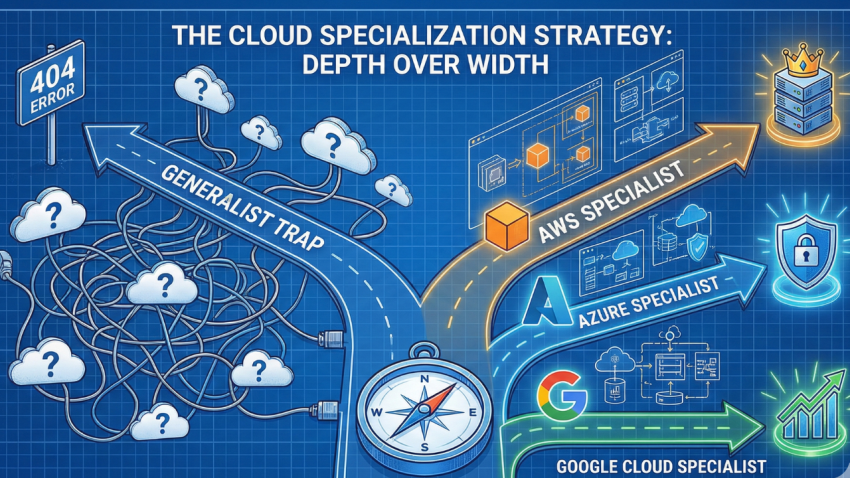
Here is the reality of the industry: Employers do not hire “Cloud Generalists.” They hire AWS Solutions Architects. They hire Azure Administrators. They hire Google Cloud Engineers.
If you are new to the field, trying to learn all three platforms simultaneously is like trying to learn French, Spanish, and Italian at the same time. You might recognize a few words in each, but you won’t be fluent enough to hold a conversation in any of them.
The Depth vs. Width Problem
When a company moves its infrastructure to the cloud, it picks an ecosystem. If they pick AWS, they are all in. They need someone who knows the specific quirks of EC2 instances, S3 bucket policies, and IAM roles.
They do not care if you vaguely know how Google Drive works.
This is where many cloud computing courses fail their students. They offer a “buffet” style curriculum—a week on AWS, a week on Azure, a week on Google. The student leaves with a certificate but zero practical ability to manage a production environment.
You need to go deep, not wide. You need to understand the “governance” of a specific platform—how to manage costs, how to secure endpoints, and how to configure compliance rules. These aren’t generic concepts; they are platform-specific skills that require hundreds of hours of practice.
The “Business” of Cloud
This brings us to the second major gap in most self-taught plans: The Business Logic.
Technical skills (like spinning up a server) are easy. Anyone can watch a YouTube video and launch a virtual machine. But can you explain why that machine should be in the cloud? Can you calculate the ROI? Can you design a disaster recovery plan that ensures business continuity if that region goes down?
Real-world cloud computing online training doesn’t just teach you which buttons to click. It teaches you the “Cloud Essentials”—the governance, risk management, and compliance standards that keep a company from getting sued or going bankrupt from a surprise bill.
Pick a Track, Stay in Your Lane
So, what is the strategy?
- Build the Foundation: Before you touch a cloud platform, you need to understand the basics of IT. Networking, hardware, and security fundamentals are non-negotiable. If you don’t know what an IP address is, you have no business configuring a Virtual Private Cloud (VPC).
- Choose Your Ecosystem: This is the most critical decision you will make.
- AWS: The market leader. Huge demand, but huge competition.
- Azure: The corporate standard. If you want to work in large enterprises that already use Microsoft, this is your home.
- Google Cloud: The innovator. ideal for data-heavy roles and startups.
- Get Certified in THAT Ecosystem: Don’t get a generic “Cloud Certificate.” Get the AWS Certified Cloud Practitioner or the Microsoft Certified: Azure Fundamentals. These tell an employer exactly what you know.
The Verdict
The most effective training programs recognize this reality. They don’t force you to learn everything. They force you to specialize. They offer specific tracks—Track I for Azure, Track II for AWS, etc.—so that when you graduate, you aren’t a “Jack of all trades, master of none.” You are a specialist ready to deploy on Day 1.
So, stop trying to learn the whole sky. Pick a cloud, and master it.