
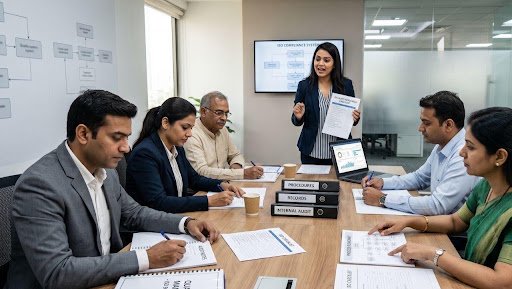
Quality management depends on consistent processes, trained personnel, effective monitoring, and continual improvement. Organisations need professionals who can evaluate processes, identify gaps, and support corrective actions.
An internal auditor training course can help employees build practical auditing skills to review management systems within their organisations. Training typically focuses on audit planning, evidence collection, compliance evaluation, reporting, identifying nonconformities, and verifying corrective actions. These skills can help professionals contribute to stronger internal controls and better audit readiness.
Building Practical Skills Through Internal Audit Training
Effective auditor preparation combines structured learning with practical understanding of audit activities, helping professionals approach organisational assessments with greater confidence.
1. Understanding Internal Audit Responsibilities
Internal auditors need to understand their responsibilities before conducting an assessment. Training introduces participants to audit planning, evidence collection, compliance evaluation, reporting, and corrective-action verification. These skills help employees review organisational processes systematically and identify areas that may need improvement. A structured learning approach also helps participants understand how to document and communicate audit findings to relevant stakeholders.
2. Developing Effective Audit Planning Skills
Planning establishes the foundation for an organised audit. Participants learn how to define audit objectives, understand the scope, prepare appropriate questions, and organise available information before assessment activities begin. Proper planning helps auditors focus on relevant processes and gather meaningful evidence. It also supports better time management during audits and creates a clear structure for documenting observations and findings.
3. Strengthening Evidence Collection Techniques
Auditors need reliable evidence to evaluate whether processes are being implemented effectively. Training can introduce methods for reviewing records, interviewing personnel, observing activities, and examining documented information. Evidence-based assessment helps auditors distinguish between assumptions and verifiable findings. This approach supports clearer reporting and enables organisations to understand the actual condition of their management processes.
4. Identifying Nonconformities And Improvement Areas
A key responsibility of internal auditors is recognising when established requirements or procedures are not being followed effectively. Training helps participants identify and document nonconformities objectively. Clear findings can then support corrective actions and process improvements. This makes internal auditing more than a compliance exercise by connecting assessment results with opportunities to strengthen organisational performance.
5. Improving Audit Reporting And Communication
An audit becomes useful when its findings are communicated clearly. Training develops skills for preparing structured reports that explain observations, evidence, nonconformities, and improvement opportunities. Effective communication allows management and process owners to understand findings without unnecessary ambiguity. Clear reporting can also support follow-up activities by providing a documented basis for reviewing whether corrective actions have been implemented successfully.
Quality Management Training Supporting Audit Readiness
Strong quality systems depend on people who understand processes, requirements, risk, documentation, and continual improvement across different organisational functions.
Professionals seeking an internal auditor training course can benefit from learning environments that combine auditing concepts with practical exercises, case studies, and real-world scenarios. Training focused on quality management and auditing can help participants plan and execute audits, evaluate process effectiveness, and report findings. Such preparation is useful for quality managers, professionals responsible for management-system implementation, employees whose roles affect quality performance, and individuals seeking to develop auditing capabilities.
1. Connecting Training With Organisational Processes
Auditing skills become more valuable when professionals understand how different organisational processes interact. Training can help participants examine workflows, responsibilities, records, and controls as connected elements rather than isolated activities. This broader perspective enables auditors to identify process weaknesses and understand how individual findings may affect overall system performance and organisational objectives.
2. Supporting Consistent Process Evaluation
Consistency is important when different auditors review processes within the same organization. Structured training helps participants develop a common understanding of audit methods, evidence requirements, findings, and reporting practices. Consistent evaluation can improve the quality of internal audits and make findings easier for managers and process owners to interpret and address.
3. Encouraging Continual Improvement
Audits can provide valuable information for improving processes when findings are reviewed constructively. Training encourages professionals to look beyond individual gaps and consider recurring issues, process inefficiencies, and opportunities for improvement. This approach supports a continual-improvement culture where audit results contribute to stronger processes rather than simply becoming records maintained for compliance purposes.
4. Strengthening Corrective Action Follow-Up
Identifying a problem is only one part of effective auditing. Follow-up helps determine whether corrective actions have addressed the underlying issue. Training can help auditors understand how to review corrective actions and assess their effectiveness. This creates a stronger connection between audit findings and measurable process improvement while helping organizations maintain better control over recurring weaknesses.
5. Preparing Professionals For Different Industries
Quality and auditing skills can be applied across manufacturing, healthcare, information technology, construction, logistics, energy, food, and service sectors. Training therefore provides professionals with transferable knowledge that can support different organizational environments. The ability to understand processes, evaluate evidence, document findings, and support improvement remains relevant regardless of the specific industry or operational setting.
Strengthening Quality Practices Through Structured Learning
Structured quality training helps organizations develop internal capabilities while giving employees a clearer understanding of auditing, process evaluation, documentation, and improvement activities.
An ISO quality management system training approach can help professionals build knowledge needed to establish, implement, maintain, and audit quality management systems. Training programs may also include practical exercises, case studies, delegate exercises, and real-world scenarios to connect concepts with workplace situations. This practical focus can help participants apply their learning more effectively.
Conclusion: Turning Training Into Stronger Audit Readiness
Effective training can strengthen audit capabilities by improving planning, evidence collection, reporting, nonconformity identification, corrective-action verification, and continual improvement. When employees understand these activities, organisations can develop stronger internal auditing practices and become better prepared for assessments.
For professionals seeking structured quality and auditing education, KBS Certification Services Ltd. offers training programs covering quality management, internal auditing, lead auditing, and related management-system areas. Their programs include instructor-led learning, practical exercises, case studies, and customised training options, supporting professionals who want to build practical auditing and quality-management capabilities.