
Passing a driving test proves you can steer, brake, park, and follow the rules on a given day. It doesn’t prove you can handle a tailgater on a six-lane highway, a sudden downpour on oily asphalt, or a distracted driver drifting into your lane. Those are the moments that decide whether a trip ends safely.
That is why selecting the best manual car driving course, or any serious driver training program, means looking past the minimum needed to pass and asking what a course teaches about real-world risk. Here is what advanced driver training should cover, and why each element matters.
Why Licensing Is Only The Starting Line
The numbers show how much is at stake. According to the World Health Organization, roughly 1.19 million people die in road traffic crashes every year, and road injuries are the leading cause of death for people aged 5 to 29. Two-thirds of road deaths occur among people of working age, between 18 and 59, and more than half involve vulnerable road users such as pedestrians, cyclists and motorcyclists.
Distraction, speed, fatigue and impairment are among the major risk factors. A basic license course is designed to produce legal, competent beginners. Advanced training aims for something different: drivers who anticipate problems early and have the skills to respond calmly.
Hazard Perception: Seeing Trouble Before It Arrives
Experienced drivers don’t just react; they predict. Hazard perception training teaches learners to scan far ahead, check mirrors regularly, and read the behavior of other road users. A car drifting within its lane, a driver looking down at a phone, or a pedestrian near a parked vehicle all signal potential danger seconds before it happens.
Good training builds this habit with commentary driving, where the learner says aloud what they notice and what they plan to do, and with video or simulator exercises. The goal is to shift from “What just happened?” to “What might happen next?”
Space, Speed, and Following Distance
Most collisions involve too little space, too much speed, or both. Advanced training should teach:
- A safe following distance: A safe following distance is commonly at least two seconds in good conditions and more in rain, heavy traffic, or when following large vehicles.
- Speed matched to conditions: Speed matched to conditions, not just the posted limit.
- Lane position and escape routes: Lane position and escape routes so you always have somewhere to go.
- Smooth braking and acceleration: Smooth braking and acceleration, which reduce risk and stress on the vehicle.
- Safe merging, overtaking and roundabout use: Safe merging, overtaking and roundabout use, including judging gaps and signaling clearly.
Practicing these skills on high-speed multi-lane roads, not just in a quiet training area, builds confidence where it counts.
Vehicle Control: Manual And Automatic
Technical control is part of safe driving, and the two transmission types call for different skills. Selecting the best manual car driving course should mean looking for training that goes beyond finding the biting point. Strong programs teach smooth clutch control, hill starts without rolling back, appropriate gear selection and engine braking, as well as how to avoid stalling in traffic. Manual drivers can also drive automatic cars, which is one reason many learners choose it.
Automatic training has its own lessons: smooth throttle and brake use, correct use of drive modes, proper stopping and parking sequences, and avoiding mistakes such as pressing the wrong pedal in a stressful moment. For both types, instructors should teach emergency braking, steering correction, and how modern safety systems, such as ABS and stability control, behave when they activate.
Driving In Challenging Conditions
Conditions change quickly, and good drivers adjust before problems appear. In a region like the UAE, advanced training should address:
- Heat: tire pressure, overheating warning signs, and how air conditioning affects the vehicle.
- Sudden rain: longer braking distances, reduced grip, and the danger of the first minutes of rain, when oil rises to the surface.
- Fog and low visibility: reducing speed, using appropriate lights and keeping a safe distance.
- Sand and dust: reduced visibility and slippery surfaces.
- Night driving: glare, reduced depth perception and fatigue.
Learners who’ve practiced these scenarios, even in simulation or discussion, are far better prepared when they meet them for real.
Sharing The Road With Vulnerable Users
With more than half of road deaths involving pedestrians, cyclists and motorcyclists, courtesy and awareness need to be part of the curriculum. That means checking blind spots, giving motorcyclists space, expecting pedestrians at crossings and slowing in residential or school zones. It also means understanding that a driver’s mistake costs vulnerable users far more than it costs the driver.
Managing Fatigue, Distraction And Emotion
Many crashes come from the driver, not the road. Advanced training should cover phone use and other distractions, the dangers of drowsy driving, the effects of medication and alcohol (the UAE has a zero-tolerance policy on drinking and driving), and managing frustration. Techniques such as planning routes in advance, taking breaks on long journeys, and staying calm in traffic reduce risk more than any piece of technology.
Emergencies And What To Do After a Crash
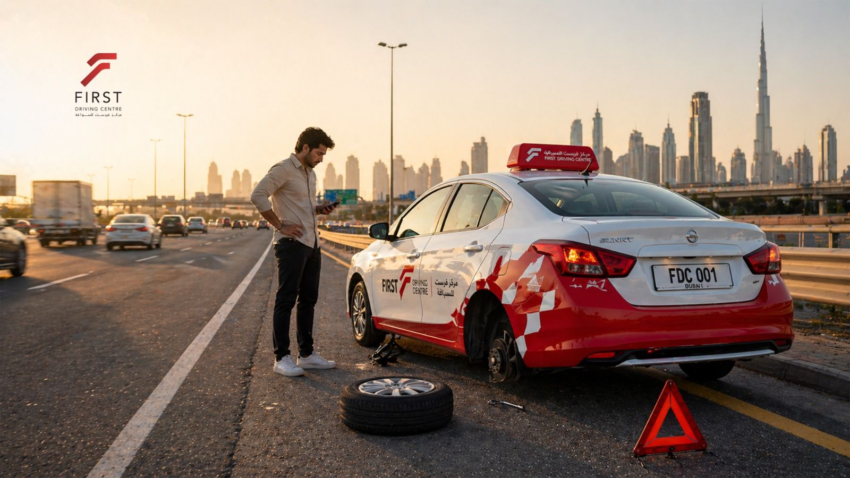
Few learners ever practice emergencies, yet these are the moments when preparation counts. Good courses explain how to respond to a tire blowout, a skid, brake fade, or a stalled vehicle on a highway. They also cover what to do after a collision: securing the scene, switching on hazard lights, checking for injuries, calling emergency services, and following local reporting procedures. WHO notes that delays of even minutes in post-crash care can make the difference between life and death, so knowing how to act quickly matters.
Conclusion
Advanced driver training should build judgment, not just technique. It should teach hazard perception, safe space and speed management, strong vehicle control, readiness for local conditions, respect for vulnerable road users, and calm responses to emergencies. These skills turn a licensed driver into a safe one. Whether you’re comparing the best automatic car driving course or a manual option, look for programs that prepare you for the roads you’ll actually use, with instructors who teach why as well as how. Safe driving is a habit, and the right training starts building it from the first lesson.
First Driving Centre is an RTA-authorized driver training and licensing center in Dubai, offering light motor vehicle courses in manual and automatic, plus VIP and motorcycle programs. They combine practical road training, theory classes, and testing services, helping learners build the safe-driving habits that go beyond passing the test.