
A heat exchanger can only perform well when its tubes stay clean. Over time, deposits build up inside the tubes and begin to affect performance. Cleaning those deposits becomes an important part of regular maintenance. This is where tube cleaners come into the picture.
Many maintenance teams often find themselves choosing between pneumatic and electric tube cleaners. At first glance, both seem to do the same job, but the way they operate creates important differences in performance, portability, safety, and maintenance requirements.
Whether working with equipment at multiple locations or maintaining a fixed facility, understanding the strengths of each option helps make the right choice. Many Pneumatic tube cleaners suppliers offer solutions designed for different cleaning conditions, while a portable pneumatic tube cleaner remains a popular choice for sites that require mobility and flexibility.
Understanding What Both Cleaning Systems Actually Do
Both pneumatic and electric tube cleaners are designed with the same purpose: removing fouling from heat exchanger tubes. They work by driving a rotating cleaning tool through the inside of a tube . This cleaning tool may be a brush, cutter, or buffing attachment. As it moves through the tube, it breaks up deposits and helps restore cleaner internal surfaces.
The main difference lies in the power source :
- Pneumatic tube cleaners use compressed air.
- Electric tube cleaners use electricity.
While this may sound like a small difference, it affects several practical aspects of operation, including:
- Safety conditions
- Mobility
- Torque consistency
- Cleaning efficiency
- Operating costs
Choosing between the two often depends more on the working environment than on the cleaning task itself.
Pneumatic Tube Cleaners : Best Suited for Mobile and Wet Environments
Pneumatic tube cleaners are widely used in locations where mobility and safety are important considerations.
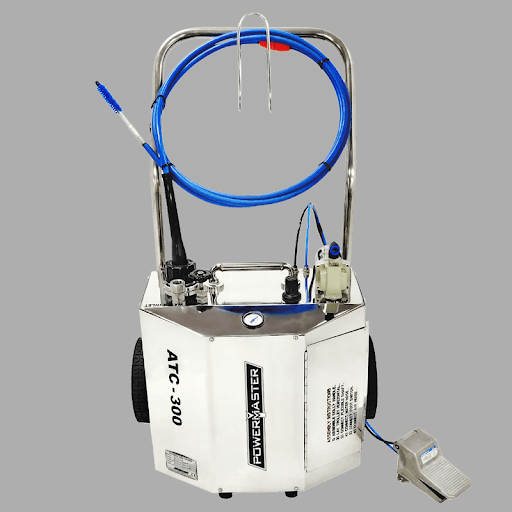
Powermaster offers portable pneumatic models such as:
- C-10
- ATC-100
- ATC-300
One notable feature of these tools is their hollow shaft design. During operation, water flows through the shaft while the cleaning tool rotates. This allows loosened deposits to be flushed away immediately.
This approach offers several benefits:
- Faster cleanup after cleaning
- Continuous flushing of deposits
- Reduced downtime during maintenance
A portable pneumatic tube cleaner is especially useful in environments where electricity may create additional risks.
Ideal Applications for Pneumatic Models
These cleaners perform well in:
- Wet working areas
- Locations near steam lines
- Facilities where electrical equipment may pose safety concerns
- Sites without a fixed power supply
- Maintenance work across multiple facilities
They also handle softer fouling effectively, including:
- Biofilm
- Algae
- Loose silt
- Light scale deposits
Limitations to Consider
Pneumatic systems depend completely on a steady supply of compressed air.
Some challenges include:
- Reduced air pressure over longer tube runs
- Changes in torque when compressor output fluctuates
- Less consistent cleaning performance in certain conditions
When air pressure drops, cleaning consistency can suffer, leaving some areas less effectively treated
Key Factors That Should Guide the Decision
Selecting the right cleaner becomes easier when a few practical factors are considered.
1. Site Conditions
The work environment should always be the starting point.
Choose pneumatic cleaners when:
- The area is wet
- Steam lines are present
- Hazardous zones require safer operation
Choose electric cleaners when:
- Conditions remain dry
- Reliable electrical power is available
- Proper safety controls are already in place
2. Tube Specifications
Tube size and length also influence cleaner selection.
For example:
- Short tubes often work very well with pneumatic cleaners
- The Powermaster C-10 handles tube diameters from 4.8 mm to 25.4 mm
- Longer tube lengths generally benefit from the consistent torque of electric models
3. Type of Deposit
The nature of fouling plays a major role.
Soft deposits such as:
- Biofilm
- Algae
- Loose sediment
can usually be cleaned effectively by either system.
Harder deposits often require:
- Stronger torque consistency
- Reliable cleaning force throughout the entire tube length
In such situations, electric cleaners often provide better results.
4. Mobility Requirements
For maintenance teams that travel between locations, portability becomes important.
Benefits of pneumatic systems include:
- Lightweight construction
- Compact design
- Easy transportation
- Operation with only a compressor
This is one reason why many industries continue to rely on a portable pneumatic tube cleaner for field maintenance work.
Conclusion
The choice between pneumatic & electric tube cleaners should always be based on actual operating conditions rather than guesswork .
Every facility has different requirements . Some need mobility and safety in wet environments. Others need steady torque for longer tubes and tougher deposits. Understanding these requirements helps to maintain teams and achieve better cleaning results while reducing unnecessary downtime.
For facilities looking for dependable tube cleaning solutions , working with trusted Pneumatic tube cleaners suppliers and selecting the right cleaner for the job can help maintain performance, improve cleaning efficiency, and support longer equipment life. The right tube cleaner is not just a maintenance tool, it is an investment in smoother operations and better equipment reliability.